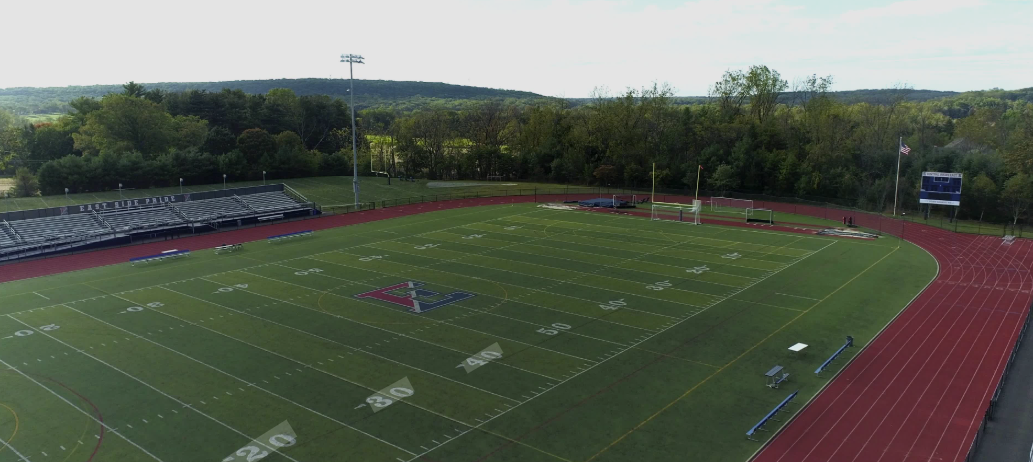

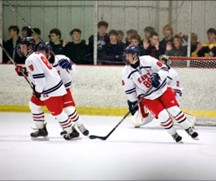





















As our spring sports wrap up, coaches and athletes alike are wondering how to improve their teams for next season. A common request for the 2026-2027 season has been to increase the available turf space for the many sports East offers, such as field hockey, boys’ and girls’ lacrosse, boys’ and girls’ soccer, flag football, and more.
The limitations of having only one turf field are endless. During pre-season, many sports cannot practice in ideal conditions because the turf space is prioritized to in-season sports. This sets the athletes back tremendously, as space constraints limit the playability of sports such as lacrosse and field hockey when confined in the gym or even the auxiliary gym. Specifically, for the girls’ lacrosse team, a vast majority of their practices were confined in these two spots during pre-season, causing chaos with bouncing, flying balls; slips; and an increase in collisions.
According to player Mackenzie Carr ’28, practicing inside during pre-season had “not enough room for almost 35 girls to fit and be throwing balls around.”
However, even worse than inside pre-season practices, the limited turf space had caused practices to be relocated or rescheduled during the regular season. Countless times had the girls’ lacrosse been obligated to reschedule practice from the turf to the grass or to a later time entirely. This was often due to other sports such as flag football or boys’ lacrosse having games, which prioritized the turf more than practice. However, this majorly impacted the events of practice as it is much harder to practice something such as lacrosse on the grass than it is on the turf.
One lacrosse player explained, “it is extremely hard to pick up a lacrosse ball on the grass.” Therefore, many times when practices were on the grass fields, the team would have a “fun practice” which typically involved relays, fun games, and team-bonding time. While this is fun and relaxing, it was not always productive. Also, practice times being rescheduled often lead to colder practices since it is much chillier outside at night than it is during the afternoon. This once again caused many practices to be less efficient, as athletes are not at their prime level of fitness when they are trying harder to stay warm than they are trying to do well in practice.
One athlete commented, “I will never forget one very cold practice in March. Since we only have one turf field and many sports, practice got pushed to eight o’clock at night. The snow came down very quickly and was extremely cold. If we had another turf, there would have been room for us to play earlier and have a more efficient practice.”
Additionally, having only one turf field provided complications during the regular season because when other sports would have games, practices were often moved to a different time than the typical afterschool 3-5PM slot. This led to many athletes having to miss practice for club practice to attend to their main sport.
Elizabeth DeLorenzo ’28, who mainly plays club soccer but plays lacrosse for school, explains that “it was pretty tough to try and make every single practice because throughout the season the times were iffy whether it would have been right after school or a little bit after and I would always have to either rush home for a quick change for soccer, if it was a little bit after school, or just completely miss [lacrosse] practice fully because we couldn’t get time for our field.”
While some may believe that the singular turf field does not significantly affect the success of our sports here at East, there are a plethora of examples to prove otherwise. Mainly, our biggest rival, CB West, has three turf fields, and it clearly shows in the statistics for nearly all sports against East. For example, varsity field hockey as well as both boys’ and girls’ lacrosse suffered heavy losses against West this year. With the additional turf fields, West athletes can guarantee relatively ideal practice conditions consistently, resulting in their high performance during gameday. With the East versus West rivalry so high, it makes only plausible sense that an effective way to defeat West is to improve practice conditions with more turf fields.
While this year was certainly successful for many different sports at East, coaches are always looking for ways to improve for next season. For the multitude of sports that utilize the turf, the limitations that arise from only having one, cause a variety of difficulties for athletes and coaches during their season. To make next year even better than this one, it seems only logical to push for more turf fields.