
























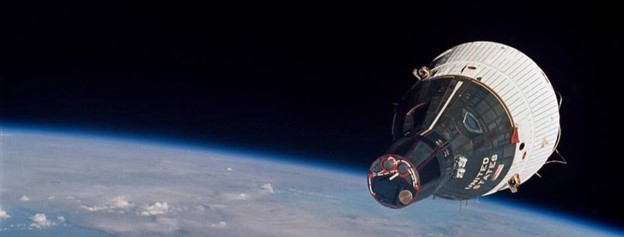
Exactly 60 years ago today, on a quiet afternoon at Cape Canaveral, the clear sky was split open by Titan II as it propelled itself through the atmosphere. The eight-thousand-pound spacecraft fractured to reveal Gemini 7, a capsule manned by Frank Borman and James A. Lovell. The launch was perfect – the two astronauts only slightly jostled in their seats – and NASA’s hopes for the mission soared. The two just embarked on a crowded yet important journey through Earth’s orbit, where for two weeks they would push the limits of what had been done in space.
Project Gemini: Prelude to the Moon Landing
Gemini 7 was the sixth launch of Project Gemini, which was America’s second human spaceflight program. After the success of Project Mercury, Gemini was the bridge between putting a man in space and landing him on the moon. Gemini consisted of launching twelve two-man spacecraft between 1964 and 1966, with the objective of improving the manual maneuvering of the spacecraft when in orbit.
Prior to Gemini 7, American history was already dotted with the successes of the project: from the first American spacewalk with Gemini 4, to setting an endurance record of eight days in orbit with Gemini 5. NASA wanted to take things a step further, Gemini 7 being their most ambitious project yet.
The primary objectives of the mission included seeing the effects of prolonged time in space on the astronauts, successfully achieving a safe rendezvous with Gemini 6A, running twenty medical and technical experiments – all in fourteen days. This time frame wasn’t random; it’s the precise time it would’ve taken to get to the moon, which was the magnum opus of the program. Gemini 7 would test the astronauts’ capabilities of tackling this time in space together.
A Packed Two Weeks
The space shared by the two men was uncomfortably tight. Lovell and Borman spent this mission in what was essentially a slightly more spacious interior of a VW Beetle front seat. Unless the hatch above them was open, they could not stand up or move around; instead, they were confined to a sitting position with two tiny windows by their side.
Every part of their schedule was performed in each other’s presence, from life-sustaining activities to medical experiments; even their sleep was synced to conduct work at the same time. The distance between them was merely six feet, the two making do with conserving space by stuffing trash behind their seats. They used sanitary wipes to keep clean in the absence of showers, shared a toothbrush on one occasion, and gritted their teeth to bear the leakage of their urine bag. As they raced through their experiments, empty time stretched, and they were engulfed in boredom. They entertained themselves with the works of Mark Twain and Walter D. Edmonds.
One objective of Gemini 7 was to see how astronauts could operate in “shirt sleeve environments,” or ones where they worked without their spacesuits. When they ascended, they were already wearing a “grasshopper” suit, which was a lightweight pressure suit with a soft hood and a zippered entry system that made peeling it off their bodies easier in cramped conditions. It weighed just a third of the average Gemini space suit, allowing for better stowage and mobility. They took turns spending time unsuited, before finding it more comfortable to spend the remainder of their voyage without them.
Among the other experiments they ran, they studied the calcium balance of their bodies and how spaceflight affected bodily fluids. They ran technical experiments too, two of which were cancelled when equipment problems arose. Problems with the spacecraft piled up towards the end of the flight – by day thirteen, two thrusters broke, and Lovell and Borman slept under the glow of warning lights informing them of malfunctioning fuel cells. Despite being worrisome, tests conducted on Earth concluded that the vessel would hold until landing.
A Rendezvous that Almost Didn’t Happen
Arguably, the most important objective of Gemini 7 was conducting a rendezvous (two spacecraft perform particular maneuvers in order to arrive at the same orbit and pass by each other). The plan was to launch two Gemini vessels in quick succession so they could pass each other. The plans came to a halt when Gemini 6, also called the Agena Target vehicle, experienced a hard start on October 25th, its fuel tanks rupturing; the launch was rendered a devastating failure.
This did not deter NASA. They decided to improvise, rebuilding the spacecraft into a new and improved Gemini 6A, which would be launched ten days after Gemini 7 to complete the rendezvous. The two spacecraft stayed near each other at fluctuating distances of 1 – 300 feet, performing station-keeping duties before 6A withdrew to a range of thirty miles.
Both spacecraft landed safely on Earth, without major complications.
A Roaring Success
The fourteen-day voyage was a record-breaking endurance flight, providing us with priceless knowledge on human endurance in space. It was the first true taste of what it would be like to work in space for long-term projects, such as the journey to the moon. Waste management, working in cramped spaces, scheduling sleep and work, and sanitation all served as lessons and experience for future missions.
Despite Gemini 7 being the first spaceflight for Lovell and Borman, the two performed spectacularly in this environment. Borman would go on to command Apollo 8, where he orbited the moon. Lovell took part in many missions under the Apollo program as well and became a mission commander on major flights. From the rendezvous that almost didn’t happen to the variety of experiments conducted in essentially a cupboard, Gemini 7 is a crucial and optimistic part of space history.

Mr Saltz • Dec 4, 2025 at 10:19 am
Great Job!!