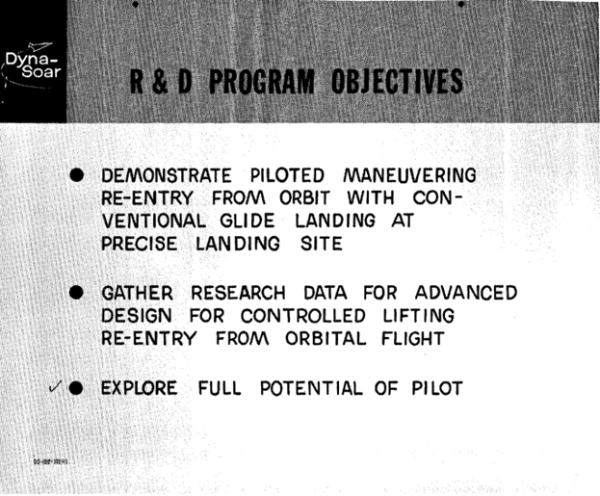




























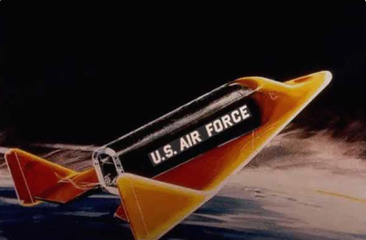
The Cold War is, at its core, a conflict of opposing ideologies. The Space Race, a crucial appendage of the battle, is not an exception, with different ideas for the future of space clashing for domination of the cosmos. However, most designs for certain technologies were similar, particularly the model for satellites: create a vehicle to enter orbit and then descend using a parachute. But just because these models are the ones that succeeded, it doesn’t mean that other designs didn’t almost reach Earth’s orbit. Enter X-20 Dyna Soar, a brainchild of the US Air Force that almost introduced an unheard concept to the skies: space flight on an aircraft vehicle.
Exactly 62 years ago today, Robert McNamara penned a cancellation of the X-20 Dyna Soar project, ending a potential timeline where aircraft meandered through space.
Dark Origins
Like many ideas of the space race, the concept of Dyna-Soar has dark, twisted roots in Nazi Germany’s numerous proposed war technologies. On April 27, 1942, a plan known as Amerikabomber was finalized, encompassing three concepts for an aircraft to reach America and drop a payload of up to 6.5 tons.
One such concept was the Silbervogel (German for ‘Silver Bird’). It was an innovative idea for a spaceflight performed by an aircraft in a series of bounces. This skip and glide technique, developed by German engineers Eugen Sänger and Irene Bredt, almost resembled a skipping stone. The aircraft would accelerate, then use lift from its wings to redirect its glide angle upward several times. This allowed it to cool off the friction when traveling through dense air. Nazi scientists believed that an aircraft dipping in and out of suborbit could hit distant targets, from New York to Los Angeles, and reduce thermal stress.
Luckily, the Silbervogel’s strategic uselessness outweighed its technological wonder, and the silver bird never spread its wings.
This did not mean that the idea was lost, however. Operation Paperclip ensured the transfer of these horrific yet brilliant minds to NASA, where the idea of an aircraft that can fly in space resurfaced, and the rough vision for X-20 Dyna-Soar was born.
Why Ascend to the Orbit?
The Dyna-Soar program was initiated on October 10, 1957, by the US Air Force, 6 days after Sputnik rocketed through Earth’s orbit. According to The Washington Post, U.S. intelligence significantly revised downward the estimated explosive yield of the Soviet Union’s largest ICBM, the SS18, shifting previous perceptions of its power.
As space began to take on greater military significance, efforts to surpass the Soviets in space technology intensified. Features such as high-quality reconnaissance and undetectability in space made Dyna-Soar important to NASA. The aircraft could also be recalled or retargeted at any point. This flexibility was impossible with missiles at the time.